What is a chatbot on your own documents?
A chatbot on your own documents is an AI assistant that does not answer from general knowledge, but from the sources you point it to: policies, manuals, protocols, contracts or a knowledge base. The technique behind it is called RAG, short for retrieval-augmented generation. The assistant first looks up the passages that match the question and only then writes an answer, with a reference to the source.
That difference from an ordinary chatbot is large. ChatGPT gives a fluent answer, but not from your sources and without showing where it comes from. An assistant on your own documents stays close to your own rules and shows what an answer is based on.
When is an existing tool enough?
There are tools where you upload documents and ask questions about them, such as Google's NotebookLM, a custom GPT in ChatGPT or an agent in Microsoft Copilot. For many teams, that is a fine start. A tool is usually enough if:
- it concerns a limited set of documents that does not change often;
- there is no personal data or confidential material in the documents or the questions;
- a wrong answer is annoying, but does no harm;
- the users can judge for themselves whether an answer is right.
Feel free to start there. You quickly learn which questions people actually ask, and that is exactly the information you need if you later have something built.
When do you have one built?
A custom build makes sense in three situations.
1. A wrong answer has consequences
When it comes to rules, rights or money, a wrong answer costs more than no answer. Then you want to see, for each statement, what it is based on, and you want the assistant to stay silent when no source covers the question.
2. Questions may contain personal data
People describe a situation the way they would tell a colleague, with names and details. In a standard tool, that data goes straight to the vendor. With a custom build, you can remove it before it reaches the model. More on this in can you put customer data into ChatGPT?.
3. The assistant has to fit into your own work
For example, inside an existing system, with your own branding, with sources that are updated every night or with fixed rules about what the assistant does and does not answer.
| Existing tool | Custom build | |
|---|---|---|
| Set-up | Hours to days | Weeks, with a trial version first |
| Source with the answer | Usually a reference to the document | Per statement, down to the passage, with checks |
| Sensitive data | You watch what you enter yourself | Can be filtered out beforehand |
| Where the data is stored | With the tool's vendor | Your choice, for example within the EU |
| Adapting to your process | Limited | Fully |
| Costs | Subscription per user | One-off build, then maintenance |
What makes an assistant reliable: four lessons from Bronwijzer
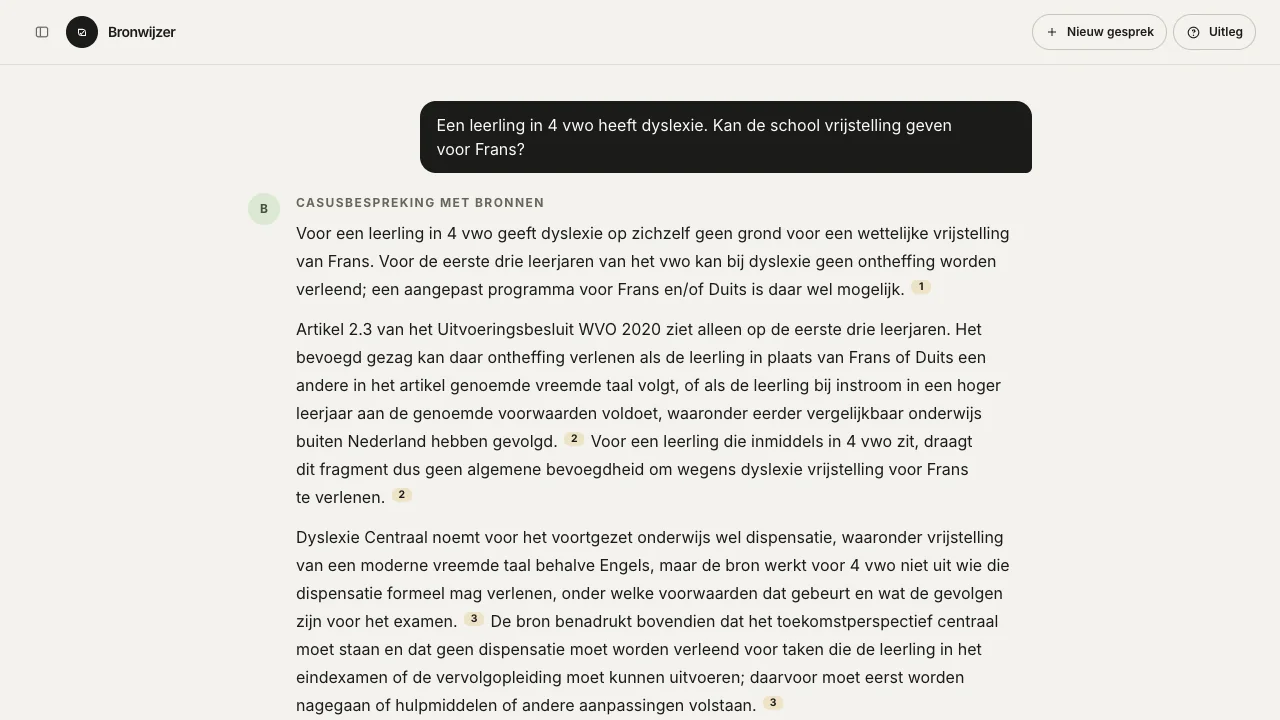
Bronwijzer is an AI assistant I built for regional partnerships for inclusive education. Professionals in secondary education describe a case and get the passages from official sources that apply to it. The assistant is in a testing phase with the client. These four choices make the difference between a nice demo and something you can build on.
No source, no answer
Bronwijzer does not make up rules. If no source covers the question, the assistant says so, instead of guessing. That sounds obvious, but a language model does not do it by itself: it always wants to give an answer.
Every statement is checked
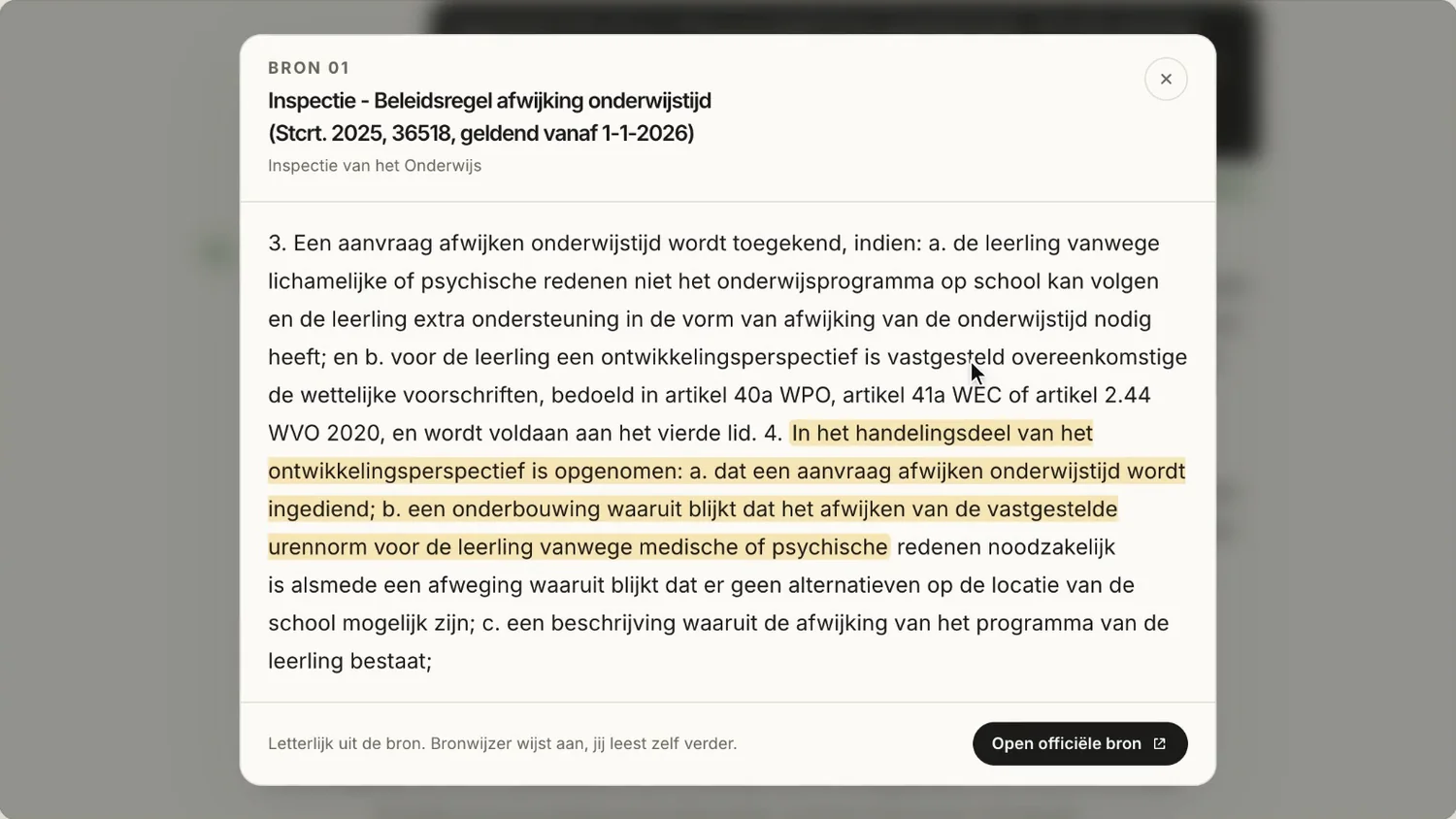
After the answer is written, a second step checks every statement against the fragments that were found. Whatever is not supported is removed. Behind what remains is a source number. Click it and you read the passage word for word; a PDF opens on the right page, with the passage highlighted.
Sensitive data stays out
Citizen service numbers (BSN), IBANs, email addresses and phone numbers are blocked. First names are replaced on the device itself by roles such as pupil or parent, followed by a further safety net. There are no accounts and no cookies, and the hosting is in the EU.
Measuring after every change
A fixed set of test cases runs after every change, in at least three rounds. One round does not count as a measurement, because the same model does not give the same answer every time. The sources themselves were added page by page or PDF by PDF, without broad crawls, and every night the system checks whether they are still up to date.
What does a chatbot on your own documents cost?
With an existing tool, you pay per user per month. With a custom build, you pay for building it and then for the maintenance. At STN Studio, implementation projects usually start from €2,000. What an assistant on your sources costs depends mainly on four things:
- The sources. How many are there, what form are they in, and how often do they change?
- The requirements for checking. One source per document is simpler than a check per statement.
- The integrations. Does the assistant have to run inside an existing system, or work with logins and permissions?
- The maintenance. Who keeps the sources up to date and who keeps an eye on the quality?
On top of the build, expect ongoing costs: the hosting, the language model that is billed per question and keeping the sources up to date.
How to start: five questions beforehand
- Which questions keep coming back in your organisation?
- Where are the answers now, and who maintains those documents?
- What happens if the assistant gives a wrong answer?
- Could the questions or the documents contain personal data?
- Who makes the final decision: the assistant or the professional?
For that last question, the answer at Bronwijzer is always the same. The assistant shows what room the rules allow. The judgement stays with the professional. That is what AI looks like when it takes over the searching and leaves the judgement to people. Also read how STN Studio builds custom AI software.
Frequently asked questions
What is a RAG chatbot?
RAG stands for retrieval-augmented generation. The chatbot first looks up the relevant passages in your own documents and only then writes an answer, with a reference to the source. That makes answers verifiable.
Can a chatbot on your own documents still make mistakes?
Yes. The risk is smaller than with a general chatbot, but it does not disappear. That is why a check per statement, a rule that the assistant stays silent without a source, and fixed test questions after every change all help.
What is the difference from ChatGPT?
ChatGPT answers from general knowledge. A chatbot on your own documents answers from your sources, shows the source and can be given its own rules about what it does and does not answer.
Where is our data stored with a custom chatbot?
You agree on that beforehand: which sources the system uses, where data is stored and which models are used. With Bronwijzer, the hosting is in the EU and there are no accounts or cookies.