What does the Dutch Data Protection Authority say?
On 6 August 2024 the Dutch Data Protection Authority (Autoriteit Persoonsgegevens, AP) warned that using AI chatbots can lead to data breaches. The AP had received reports from organisations where employees had entered personal data of, for example, patients or customers. The examples: a GP practice with medical data and a telecoms company with customer addresses.
The AP makes a distinction here that you need to know:
- Against the agreed rules. If an employee uses a chatbot when that is not allowed, and enters personal data, there is a data breach. Reporting it to the AP and to the people affected is mandatory in many cases.
- As policy. If the use is part of the organisation's policy, then according to the AP it is not a data breach, but it is often not legally permitted.
The AP's advice: make clear agreements on whether employees may use chatbots and which data they may enter, and where necessary agree with the provider that entered data will not be stored.
In July 2026 the AP published new resources: guidance on generative AI and the GDPR, and a tool to check whether your organisation wants to, is able to and is allowed to use generative AI. The first step in it is to check whether it can also be done without personal data.
Which version trains on your data?
Which version you use makes a big difference. This is what the providers' own documentation says:
| Provider | Personal versions | Business versions |
|---|---|---|
| OpenAI (ChatGPT) | Free, Plus and Pro: input can be used for training; you can turn that off | Business, Enterprise, Edu and the API: not by default |
| Microsoft | Not reviewed for this article | Microsoft 365 Copilot: prompts, responses and your business data are not used to train the foundation models |
| Anthropic (Claude) | Free, Pro and Max: you choose whether your chats are used for training | Business products and the API: not by default |
| Google (Gemini) | With history turned on, chats are used for training and can be read by people | Google Workspace: not without your permission |
Google itself writes, for the personal version, that you should not enter confidential information into it. That is a useful rule of thumb for any personal account.
Not training on it does not make it allowed
This is where it often goes wrong. A provider not using your input for training does not mean you may put customer data into it. The data still goes to another party, and the GDPR sets requirements for that. The AP mentions, among other things:
- A legal basis and a purpose. You need a legal basis to process personal data, and the purpose must be specific and set in advance. Data you received to handle an order may not simply be used for something else.
- A data processing agreement. If a supplier processes personal data on your behalf, your arrangements must be put in writing. Business versions usually offer such an agreement; a free or personal account typically lacks one.
- Special categories of personal data. Processing data about someone's health and other special categories of personal data is prohibited, unless the law provides an exception. For healthcare, education and social work this is the most important rule.
- A DPIA for high risk. If processing is likely to result in a high privacy risk, a DPIA (data protection impact assessment) is mandatory beforehand.
- Reporting data breaches. If a data breach has to be reported, you report it to the AP within 72 hours of becoming aware of it.
What you can almost always do: anonymise
For most work you do not need the personal data. Rewriting an email, summarising a complaint or thinking through a case works just as well with 'the customer' and 'the supplier' as with real names. Take out what the question does not need:
- Replace names with roles: customer, colleague, pupil, parent.
- Leave out addresses, phone numbers, email addresses, the citizen service number (BSN) and account numbers.
- Leave out details that would still make someone recognisable, such as a rare job in a small village.
- Do not paste whole documents or email threads when a few sentences are enough.
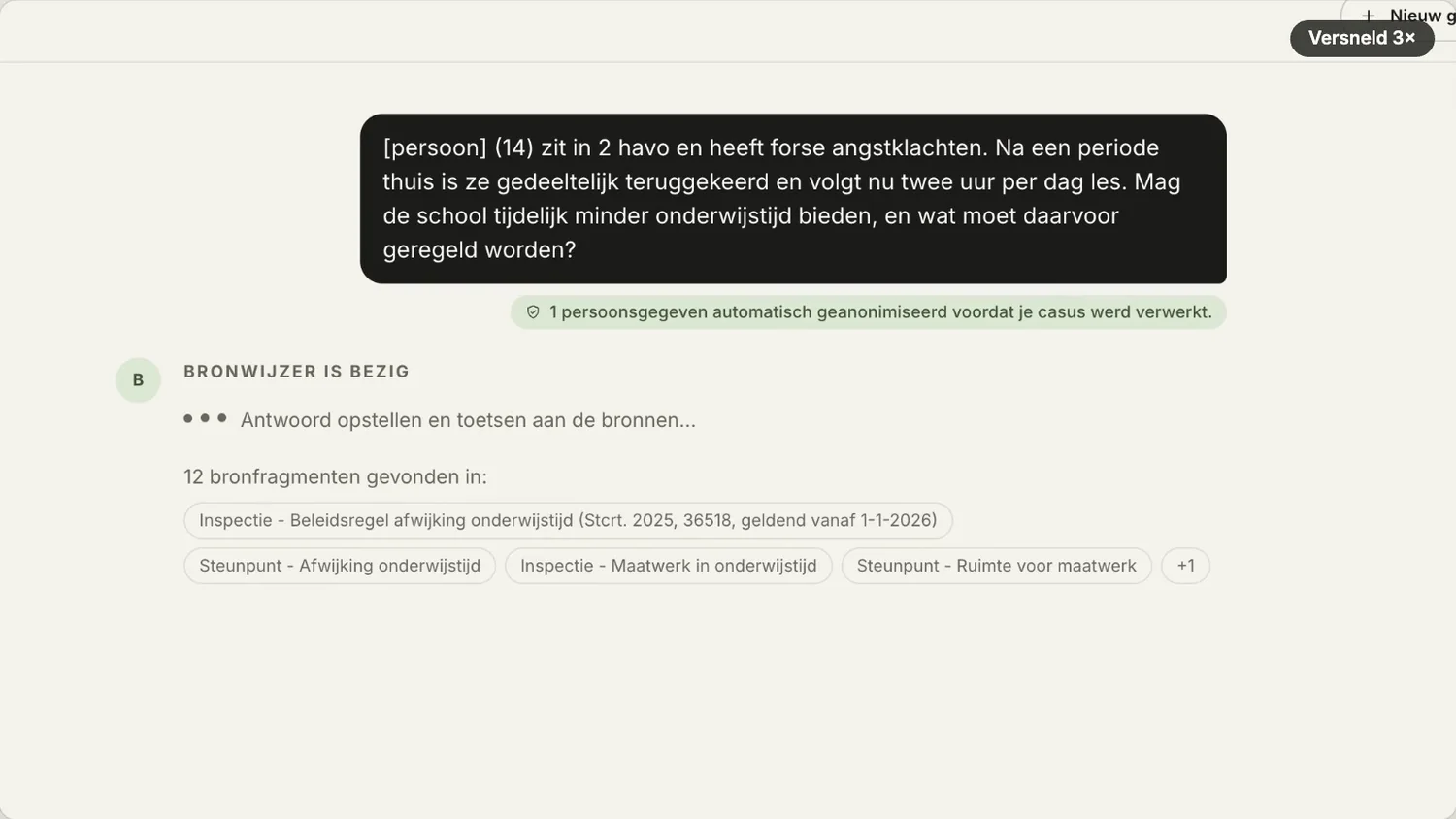
In Bronwijzer, an AI assistant I built for education, this happens automatically. BSNs, IBANs, email addresses and phone numbers are blocked, and first names are replaced on the device itself with roles such as pupil or parent, before the question reaches a language model. That shows you can build an assistant in a way that lets people simply describe their work without sensitive data going along with it.
Five working agreements for your team
The AP asks for clear agreements. This is a set a small team can start with. It is practical advice, not a legal review:
- Which tools are allowed. Choose a business version and state that personal accounts are not used for work.
- What data never goes in. Health data, citizen service numbers (BSN), financial data about individuals and anything shared with you in confidence.
- Anonymising as the default. Names become roles, unless there is a good reason and it has been agreed.
- A person checks. Anything that goes to a customer is read through by someone.
- What to do if it goes wrong. Who do you report it to, and within what time? A notifiable data breach must be reported to the AP within 72 hours.
Agreements like these are also one of the measures that belong to AI literacy. In AI training from STN Studio they are drawn up based on your own team's work. If an assistant has to handle sensitive questions on a regular basis, custom software with a filter in front of the model is often the better route.
Frequently asked questions
Is ChatGPT safe for businesses?
That depends on the version and on what you enter. According to OpenAI, with ChatGPT Business, Enterprise, Edu and the API your business data is not used for training by default. In addition, the use must comply with the GDPR, which means, among other things, a legal basis and a data processing agreement.
What data should you not share with ChatGPT?
No personal data of customers, patients or pupils in a personal account, and nowhere health data, citizen service numbers (BSN) or other special or confidential data without a legal basis and agreements in place for it.
Is it a data breach if an employee puts customer data into ChatGPT?
According to the Dutch Data Protection Authority it is, if the employee uses the chatbot against the agreed rules and personal data has been entered. Reporting it to the AP and to the people affected is then mandatory in many cases.
Can I use ChatGPT if I anonymise the data first?
Data that can no longer be traced back to a person does not fall under the GDPR. Note that just removing a name is not always enough: a combination of details can also make someone identifiable.
Sources
- Autoriteit Persoonsgegevens (Dutch Data Protection Authority): Let op: gebruik AI-chatbot kan leiden tot datalekken [Warning: using an AI chatbot can lead to data breaches] (6 August 2024)
- Autoriteit Persoonsgegevens (Dutch Data Protection Authority): new GDPR guidelines for generative AI (13 July 2026)
- Autoriteit Persoonsgegevens (Dutch Data Protection Authority): Verwerkersovereenkomst [Data processing agreement]
- Autoriteit Persoonsgegevens (Dutch Data Protection Authority): Grondslagen AVG uitgelegd [GDPR legal bases explained]
- Autoriteit Persoonsgegevens (Dutch Data Protection Authority): Wat zijn persoonsgegevens? [What is personal data?]
- Autoriteit Persoonsgegevens (Dutch Data Protection Authority): Data protection impact assessment (DPIA)
- Autoriteit Persoonsgegevens (Dutch Data Protection Authority): Zo meldt u een datalek [How to report a data breach]
- OpenAI: Enterprise privacy
- OpenAI Help Center: How your data is used to improve model performance
- Microsoft Learn: Data, Privacy, and Security for Microsoft 365 Copilot
- Anthropic: Updates to Consumer Terms and Privacy Policy
- Google: Gemini Apps Privacy Hub
- Google Workspace: Generative AI in Google Workspace Privacy Hub